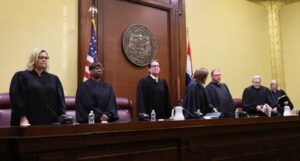
The Missouri Supreme Court voted Monday to remove Michael Thornhill, a judge in St. Charles County, from the bench. In a unanimous ruling, the state’s highest court said Thornhill could not continue serving as a judge, citing repeated political statements he made from the courtroom, including remarks about candidates and ballot measures he supported.
Thornhill, a Republican, drew national attention earlier this year after photographs of him dressed as Elvis Presley circulated online, PBS St. Louis reported.
The Supreme Court ruling stated Thornhill “failed to maintain order and decorum in the courtroom, in his chambers, and in the courthouse and further failed to maintain the dignity appropriate of judicial office,” due to his choice of attire and habit of playing Presley’s music on his phone.
According to the ruling, Thornhill had initially agreed to resign following a six-month suspension without pay and an additional 18-month period during which he would be permitted to return to the bench. The court said in Monday’s decision, however, that he must step down immediately.
Thornhill sought to revisit the terms of that agreement in November, arguing that he had suffered “public, irreparable harm to his reputation” because of media coverage surrounding the case. His attorneys asked the Missouri Supreme Court to void the original agreement and reduce the suspension from six months to 60 days, a request the court unanimously rejected.
If the Supreme Court strikes down race-based districts, the GOP could gain nine or more seats in Congress, according to some estimates. That seems likely, since most of the conservative justices said they were against the Civil Rights era restriction during oral arguments two months ago.
“It’s potentially really important for 2026,” Kyle Kondik, managing editor of Sabato’s Crystal Ball at the University of Virginia Center for Politics, told the New York Post.
Section 2 of the Voting Rights Act of 1965 is what we’re talking about. It says that no law or map can deny someone the right to vote because of their race or color. In practice, Democrats have used the law to build blue districts in largely red states.
Kondik explained, “If it comes and it completely changes our understanding of Section 2 and doesn’t protect these districts anymore, you could have a significant impact. You could see several states in the South potentially eliminating Democratic districts in states like Alabama, Louisiana, and Tennessee.”
